
Luxury Home Interior Design Ideas: 20 Elegant Ways to Create a High-End Home

Luxury home interior design is not simply about expensive furniture or decorative objects. A truly luxurious home feels sophisticated because of its proportion, materials, lighting, comfort, craftsmanship, and attention to detail.
The most successful luxury interiors often use fewer elements but give each one more visual importance. A beautifully scaled sofa, statement light, natural stone surface, custom storage solution, or large piece of artwork can have more impact than a room filled with expensive accessories.
Whether you are designing an apartment, 2BHK, villa, penthouse, or large independent house, the principles of luxury home interior design can be adapted to different spaces and budgets.
What Is Luxury Home Interior Design?
Luxury interior design focuses on creating spaces that feel refined, comfortable, cohesive, and visually sophisticated.
Common characteristics include:
- High-quality materials
- Elegant furniture
- Thoughtful proportions
- Layered lighting
- Natural stone
- Premium wood finishes
- Sophisticated colour palettes
- Custom or built-in storage
- Statement artwork
- Carefully selected accessories
- High-quality textiles
- Strong attention to detail
Luxury does not necessarily mean maximalism. In many modern luxury homes, restraint is part of the design.
A well-designed luxury room should feel comfortable and inviting while maintaining a strong sense of visual quality.
20 Luxury Home Interior Design Ideas
1. Start With a Sophisticated Neutral Palette
Neutral colours create an excellent foundation for luxury interiors.
Consider:
- Warm white
- Cream
- Beige
- Taupe
- Greige
- Soft grey
- Mocha
- Charcoal
Neutral colours allow premium materials, furniture, lighting, and artwork to become the focus.
For additional depth, introduce one or two darker or richer accent colours rather than using many competing shades.
2. Use Natural Stone as a Statement
Natural stone can instantly give an interior a sense of permanence and quality.
Consider marble, granite, travertine, limestone, or other suitable natural or stone-look surfaces for:
- Kitchen counters
- Flooring
- Bathroom walls
- Coffee tables
- Feature walls
- Console tops
You do not need stone throughout the home. A single well-designed stone feature can have a powerful effect.
3. Invest in Statement Lighting
Lighting is one of the most important elements in a luxury interior.
Use a combination of:
- Statement chandeliers
- Sculptural pendants
- Wall sconces
- Floor lamps
- Table lamps
- Recessed lighting
- Accent lighting
A statement light above a dining table or in an entrance can create an immediate focal point.
4. Choose Furniture for Proportion, Not Just Appearance
Luxury furniture should fit the room correctly.
Before purchasing a sofa, bed, dining table, or console, consider:
- Room dimensions
- Ceiling height
- Walking space
- Furniture scale
- Relationship between pieces
An expensive sofa that is too large for the room will not make the interior feel luxurious.
Good proportions often create a stronger impression than high price.
5. Create a Grand Living Room Focal Point
A luxury living room benefits from a clear visual anchor.
This could be:
- Large artwork
- Fireplace
- Statement lighting
- Stone feature wall
- Sculptural furniture
- Architectural wall treatment
Once the focal point is established, arrange the remaining furniture to support it rather than competing with it.
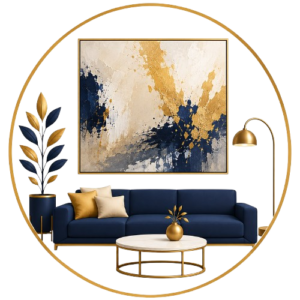
6. Use Large-Scale Artwork
Artwork can transform a luxury interior because it introduces personality without requiring excessive decoration.
Large artwork works particularly well above:
- Sofas
- Sideboards
- Beds
- Dining consoles
- Entryway furniture
Consider abstract, contemporary, botanical, landscape, monochromatic, or statement canvas artwork.
The artwork should be appropriately scaled to the wall and furniture beneath it.
A large empty wall often looks more sophisticated with one substantial artwork than with several tiny pieces scattered across it.
7. Layer Premium Textiles
Luxury is strongly connected with tactile comfort.
Layer materials such as:
- Linen
- Velvet
- Wool
- Silk-inspired fabrics
- Bouclé
- High-quality cotton
- Leather
For example, a neutral sofa can be elevated with textured cushions, a premium-looking throw, a large rug, and floor-length curtains.
Keep the colours coordinated so the textures create the interest rather than excessive pattern.
8. Add Custom or Built-In Storage
Visible clutter can quickly reduce the feeling of luxury.
Built-in cabinetry can conceal:
- Electronics
- Books
- Household items
- Clothing
- Office equipment
- Everyday accessories
Use cabinetry that visually relates to the walls or architecture.
Handleless or minimal hardware can create a cleaner contemporary appearance.
9. Create an Elegant Luxury Bedroom
The bedroom should feel calm, comfortable, and refined.
Start with:
- A substantial bed
- Upholstered headboard
- Quality bedding
- Bedside tables
- Layered lighting
- Floor-length curtains
- Soft rug
- Carefully selected artwork
A large artwork behind or opposite the bed can create a sophisticated focal point without overdecorating the room.
10. Design a Luxury Kitchen
A luxury kitchen is as much about functionality as appearance.
Consider:
- Streamlined cabinetry
- Integrated appliances
- Stone countertops
- Under-cabinet lighting
- Quality hardware
- Built-in storage
- Natural wood accents
- Minimal countertop clutter
A restrained material palette often looks more premium than combining too many finishes.
11. Create a Sophisticated Dining Area
A dining room can become one of the most dramatic areas of a luxury home.
Combine:
- Substantial dining table
- Comfortable chairs
- Statement chandelier
- Large artwork
- Sideboard
- Decorative centrepiece
Make sure the lighting is properly scaled to the dining table.
The artwork on the adjacent wall should also be large enough to relate to the furniture.
12. Use Floor-to-Ceiling Curtains
Long curtains can make ceilings appear taller and create a more finished appearance.
Where appropriate, install curtain hardware close to the ceiling and allow the fabric to fall toward the floor.
Choose fabrics that complement the room’s palette and furniture.
Neutral linen, textured cotton, velvet, and other high-quality fabrics can all work depending on the desired atmosphere.
13. Add Architectural Wall Treatments
Luxury interiors often use walls as architectural elements rather than leaving every surface plain.
Consider:
- Wall panelling
- Fluted panels
- Wood slats
- Stone
- Textured plaster
- Decorative moulding
- Large-format surfaces
Use these treatments selectively.
A feature wall behind a bed, sofa, TV unit, or dining area can be more effective than covering every wall.
14. Mix Materials With Restraint
A sophisticated luxury room often combines several materials.
For example:
Natural stone + wood + metal + glass + fabric
The secret is repetition.
If brass appears in the lighting, repeat a similar tone through cabinet hardware or a decorative object.
If natural wood appears in one area, echo it elsewhere.
This makes different materials feel connected rather than random.
15. Introduce Warm Metallic Accents
Metallic details can add refinement without dominating the room.
Consider:
- Brass
- Bronze
- Brushed gold
- Blackened metal
- Stainless steel
Use metallic finishes through lighting, furniture details, handles, mirrors, and accessories.
Choose one primary metallic finish and use it consistently.
16. Create a Luxury Entryway
The entrance creates the first impression of the home.
A luxury entryway might include:
- Console table
- Large mirror
- Statement light
- Artwork
- Decorative bowl
- Rug
- Indoor plant
Keep the arrangement relatively simple.
A large mirror and one substantial artwork can often create more impact than numerous small accessories.
17. Use Mirrors Strategically
Mirrors can increase light and create a sense of visual spaciousness.
Consider placing mirrors:
- Above consoles
- Opposite windows
- Behind dining areas
- In narrow hallways
- Above bathroom vanities
Large mirrors can also function as decorative focal points when framed appropriately.
18. Introduce Curved Furniture
Curved forms can soften the structured appearance of a luxury interior.
Consider:
- Curved sofas
- Rounded coffee tables
- Circular dining tables
- Arched mirrors
- Sculptural chairs
Combine curved furniture with straight architectural lines for contrast.
19. Add Indoor Greenery
Plants can make sophisticated interiors feel more natural and welcoming.
Use larger plants selectively in:
- Living rooms
- Entrances
- Bedrooms
- Dining areas
- Home offices
Choose planters that complement the room’s materials and colour palette.
20. Edit the Room Like a Designer
One of the most important luxury interior design principles is knowing when to stop.
After furnishing the room, remove anything that does not contribute to the overall composition.
Ask:
- Is the room visually balanced?
- Is there enough empty space?
- Is the focal point clear?
- Are the materials coordinated?
- Are the accessories necessary?
- Is the furniture correctly scaled?
Luxury often comes from intentional restraint.
Luxury Home Interior Design Ideas by Room
Luxury Living Room
Focus on comfortable furniture, premium-looking textiles, layered lighting, natural materials, and one strong focal point. Large artwork can create a sophisticated centrepiece.
Luxury Bedroom
Use an upholstered bed, high-quality bedding, layered lighting, floor-length curtains, subtle textures, and carefully selected artwork.
Luxury Kitchen
Combine streamlined cabinetry, quality countertops, integrated appliances, sophisticated lighting, and minimal countertop clutter.
Luxury Dining Room
Use a substantial dining table, comfortable chairs, a statement chandelier, and large-scale artwork to create a refined dining environment.
Luxury Home Office
Choose a well-designed desk, comfortable chair, built-in storage, layered lighting, and artwork that creates a sophisticated but focused atmosphere.
Luxury Bathroom
Use high-quality-looking surfaces, elegant fixtures, large mirrors, layered lighting, and restrained accessories. Stone and wood-inspired finishes can add warmth.
Luxury Interior Colour Ideas
A luxury palette does not need to be dark or dramatic.
Warm White and Cream
Creates an elegant and bright foundation.
Beige and Taupe
Adds warmth and sophistication.
Grey and Charcoal
Useful for a contemporary luxury aesthetic.
Black and White
Creates strong contrast and an architectural appearance.
Deep Green
Works particularly well with brass, wood, and warm neutrals.
Navy Blue
Adds richness without overwhelming the space.
Earthy Tones
Terracotta, brown, sand, and muted olive can make luxury interiors feel more natural.
A useful approach is to select a dominant neutral, a secondary neutral, and one restrained accent colour.
Luxury Home Interior Design With Natural Materials
Natural materials can make an interior feel substantial and sophisticated.
Consider combining:
- Marble or natural stone
- Natural wood
- Linen
- Wool
- Leather
- Ceramic
- Glass
- Metal
The contrast between smooth and textured materials creates depth.
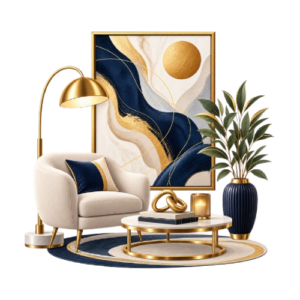
For example, a luxury living room could combine a warm neutral sofa, stone coffee table, oak console, wool rug, brass lighting, and large abstract artwork.
Modern Luxury Home Interior Design
Modern luxury focuses on simplicity, high-quality finishes, strong proportions, and sophisticated details.
Rather than using excessive ornamentation, modern luxury interiors often rely on:
- Clean architecture
- Neutral colours
- Large-scale furniture
- Statement lighting
- Natural stone
- Premium wood
- Integrated storage
- Large artwork
- Minimal accessories
The result feels luxurious because the room is carefully composed rather than heavily decorated.
Luxury Home Interior Design for Small Homes
Luxury principles can work in compact apartments and smaller homes.
The key is to avoid trying to fit too many elements into the space.
Use:
- Appropriately scaled furniture.
- A restrained colour palette.
- Built-in storage.
- Large mirrors.
- Layered lighting.
- Quality-looking materials in selected areas.
- One strong artwork or focal point.
- Clear walking paths.
A small home can feel luxurious when it is organised, cohesive, and visually calm.
Luxury Home Interior Design for Large Homes
Large homes require careful attention to scale.
Use larger furniture, rugs, artwork, lighting fixtures, and architectural features to maintain proportion.
For open-plan spaces, create defined zones for:
- Living
- Dining
- Conversation
- Reading
- Working
Avoid filling large rooms simply because space is available. Empty space can contribute significantly to a luxury aesthetic.
How to Make Your Home Look Luxurious on a Budget
Luxury does not always require a complete renovation.
Focus on the elements that have the greatest visual impact.
Improve Lighting
Replace outdated fixtures and introduce layered lighting.
Upgrade Curtains
Floor-length curtains can dramatically improve the perceived height and finish of a room.
Use Larger Artwork
A well-scaled artwork can become an instant focal point.
Declutter
Remove unnecessary objects from visible surfaces.
Coordinate Colours
Use a smaller, more sophisticated palette.
Improve Furniture Arrangement
Good spacing and proportion can make existing furniture look considerably better.
Add Texture
Rugs, cushions, throws, and curtains create depth without requiring expensive architectural changes.
Luxury Interior Design With Artwork
Artwork should not be treated as an afterthought in a luxury interior.
Instead, use it as part of the room’s design from the beginning.
Large Artwork
Ideal for creating a dramatic focal point.
Abstract Artwork
Works particularly well in modern luxury interiors.
Black-and-White Artwork
Adds sophistication without introducing strong colour.
Botanical and Nature Artwork
Can soften contemporary luxury spaces.
Gallery Walls
A carefully planned gallery wall can work in hallways, staircases, studies, and larger living spaces.
The most important consideration is scale. Artwork should relate to the wall and furniture beneath it.
Common Luxury Home Interior Design Mistakes
Using Too Many Expensive-Looking Elements
Luxury is not about displaying everything at once.
Choosing Furniture That Is Too Small
Small furniture can make a large room feel unfinished.
Overusing Metallic Finishes
Too much gold or brass can make the interior feel decorative rather than sophisticated.
Ignoring Lighting
Poor lighting can make even high-quality materials look ordinary.
Filling Every Surface
Leave visual breathing room around major furniture and decorative elements.
Mixing Too Many Styles
A luxury room needs a clear design direction.
Choosing Artwork That Is Too Small
Large walls generally require artwork with sufficient scale.
Sacrificing Comfort for Appearance
A luxury home should still be comfortable and practical for everyday life.
How to Plan a Luxury Home Interior Step by Step
Step 1: Define the design direction.
Decide whether you prefer modern luxury, classic luxury, contemporary luxury, or a more natural aesthetic.
Step 2: Establish the colour palette.
Choose a dominant neutral, secondary colour, and limited accent.
Step 3: Plan furniture according to scale.
Measure the room before purchasing major pieces.
Step 4: Select your key materials.
Choose wood, stone, metal, glass, and textiles that work together.
Step 5: Plan the lighting.
Use ambient, task, and accent lighting.
Step 6: Establish focal points.
Choose where artwork, lighting, architecture, or furniture should draw attention.
Step 7: Add textiles and accessories.
Introduce texture gradually.
Step 8: Edit the room.
Remove anything unnecessary and leave enough breathing space.
Frequently Asked Questions
What is luxury home interior design?
Luxury home interior design focuses on sophisticated materials, comfortable furniture, thoughtful proportions, layered lighting, refined colours, architectural details, and carefully selected décor.
Does luxury interior design have to be expensive?
No. Good proportions, decluttering, coordinated colours, layered lighting, appropriate artwork, and quality-looking materials can create a luxurious atmosphere without an unlimited budget.
What colours are best for luxury interiors?
Warm white, cream, beige, taupe, grey, charcoal, black, navy, deep green, and earthy tones can all create sophisticated luxury interiors.
What materials make a home look luxurious?
Natural stone, wood, linen, wool, leather, glass, ceramic, and refined metal finishes can all contribute to a premium appearance.
What artwork works best in a luxury home?
Large abstract, contemporary, botanical, landscape, monochromatic, and statement canvas artwork can all work depending on the interior style.
How do I make a small home look luxurious?
Use appropriately scaled furniture, declutter surfaces, choose a restrained palette, add layered lighting, use mirrors, select larger artwork, and introduce premium-looking materials selectively.
How can I make my living room look luxurious?
Improve furniture proportions, use a large rug, layer lighting, add quality-looking textiles, introduce a statement artwork, and keep surfaces uncluttered.
What is modern luxury interior design?
Modern luxury interior design combines clean architecture and contemporary furniture with sophisticated materials, statement lighting, restrained colours, integrated storage, and carefully selected artwork.
Final Thoughts
The best luxury home interior is not necessarily the one with the most expensive furniture or the largest number of decorative objects. It is the one where scale, materials, lighting, comfort, colour, and detail work together.
Start with a sophisticated foundation, invest in the pieces that matter most, use natural materials and layered lighting, and make artwork part of the design rather than an afterthought.
Most importantly, leave room for the space to breathe.
A genuinely luxurious home should feel comfortable, personal, elegant, and intentional – not simply expensive.
If you are exploring different interior styles, compare this guide with our Modern Interior Design Ideas, Contemporary Interior Design Ideas, Traditional & Classic Interior Design Ideas, Scandinavian Interior Design Ideas, and Rustic & Modern Rustic Interior Design Ideas. For finishing your luxury spaces with artwork, explore Large & Oversized Wall Art Ideas, Abstract Wall Art Ideas, Modern Wall Art Ideas, Black and White Wall Art, and Canvas Wall Art Ideas.